The Music Staff
The music staff (or music stave as it is also called) is the series of 5 lines and 4 spaces that music is written down on. Music notation developed from one single line, used in the early days of writing down church chants. The first person to come up with the idea of writing music down on a line was Guido of Arezzo who was a Benedictine monk and singing teacher who became famous across North Italy for the speed at which he managed to teach students to sing chants. He also invented the doh-re-me system, although it was called ut-re-me when he first developed it. If you are interested in reading more about the history and development of writing music down click here to read an article on the history of musical notation on Wikipedia and watch Howard Goodall's TV series Big Bangs which is a great introduciton into the 'Big Bangs' that changed the course of music history. It is very accessible and entertaining to watch, while at the same time being extremely informative. Highly recommended! Big Bangs is available on Amazon.com, Amazon.co.uk as movies and books or from the iBook store
The terms music staff and music stave are interchangeable. Staff tends to be the American usage and Stave tends to be the British usage. I shall use staff on this site.
Here is a picture of the staff showing the lines and spaces
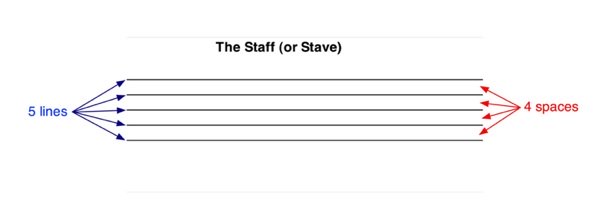
Position of the notes on the music staff
The position of notes on the lines or in the spaces determines the
pitch of the note. Pitch is how high or low a note is. The scientific
word for what musicians call pitch is frequency. The higher the note on the staff, the higher the pitch of the sound.
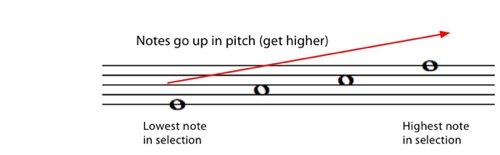
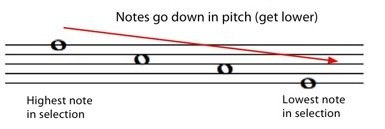
It doesn't matter which clef is used, this rule is always the same.
If the notes are higher on the staff, they are higher in pitch. If the notes are lower on the staff, they are lower in pitch.
Notes can be on a line or in a space. When a note is on a line the staff line runs through the middle of the note. When a note is in a space it sits between the staff lines. In both of the examples above the first and last notes are on lines, the middle notes are in spaces.
When two staves are joined together the Grand Staff
is made. I will use the Grand Staff as a teaching tool on this site.
You may think you only need to learn the Treble (G) or Bass (F) clef for
your particular instrument, but you will learn much faster and have a
more complete knowledge of music theory if you learn to read music using
the Grand Staff. Click here to learn about the Grand Staff and start learning how to read the notes!
A Clear Path To Learning Music Theory
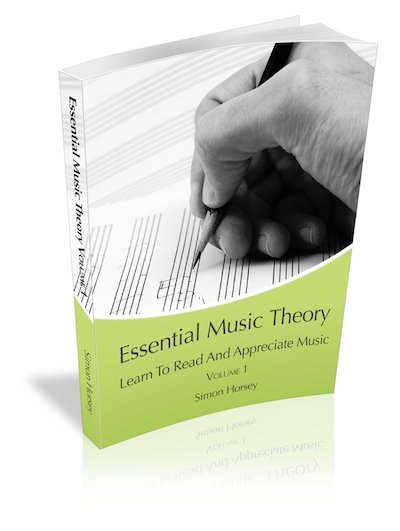

For more help check out my new theory book Essential Music Theory: Learn To Read And Appreciate Music Vol. 1 available for iPad and Mac OS.
- A simple step-by-step course that takes you from complete beginner to grade 2 music theory
- Multi-faceted learning - audio, video, mind maps, clear musical examples
- Built in quizzes to check your understanding
Click here for more information.
Or get it on the iBooks Store!
Return to Learn To Read Music from Music Staff
Return to Essential Music Theory Homepage